How to Market Vending Jobs: Complete Guide to Attracting Qualified Applicants
How to market vending jobs effectively requires more than posting a generic “vending machine operator wanted” advertisement. Vending businesses need to market the actual opportunity: pay, route, schedule, physical requirements, responsibilities, vehicle expectations, advancement potential, and what a typical workday looks like.
Vending jobs often overlap with route service, stocking, delivery, inventory management, customer service, machine maintenance, and field operations. That means the best candidates may not search specifically for “vending machine jobs.” They may search for route driver jobs, vending machine operator jobs, vending machine filler jobs, stocking jobs, delivery driver jobs, or route service technician jobs.
That search behavior should shape the recruitment strategy.
The U.S. Bureau of Labor Statistics reported approximately 2.8 million stockers and order fillers and 3.0 million laborers and freight, stock, and material movers in 2025, demonstrating the size of the broader labor pool from which vending operators can recruit. Mean annual wages were approximately $39,540 for stockers and order fillers and $42,260 for hand laborers and material movers. These figures are useful benchmarks, but they are not vending-specific wage guarantees.
For a vending business, the objective is not simply to generate applications. It is to generate qualified applicants who can reliably service a route, handle inventory, interact with location managers, operate equipment, and maintain service standards.
What Does It Mean to Market a Vending Job?
Vending job marketing is candidate acquisition
Vending job marketing is the process of promoting an open position to qualified workers through job boards, search engines, social media, local advertising, referrals, career pages, community networks, and direct outreach.
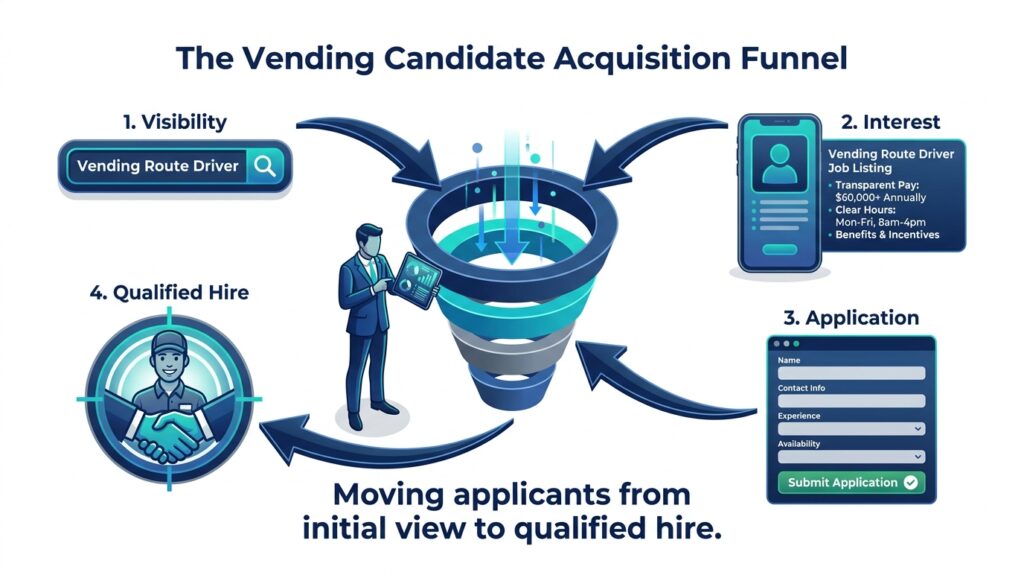
The goal is to move a candidate through four stages:
Visibility → Interest → Application → Qualified hire
A job advertisement is therefore not just an HR document. It is a recruitment landing page.
The strongest vending job marketing combines a searchable title, realistic job details, transparent compensation, clear qualifications, an easy application process, and distribution across channels where local workers actually look for jobs.
Indeed recommends using clear, industry-standard job titles and structuring descriptions around responsibilities, qualifications, salary, benefits, and other information candidates use to determine whether a role fits them.
How to Market Vending Jobs
Start with the employee, not the company
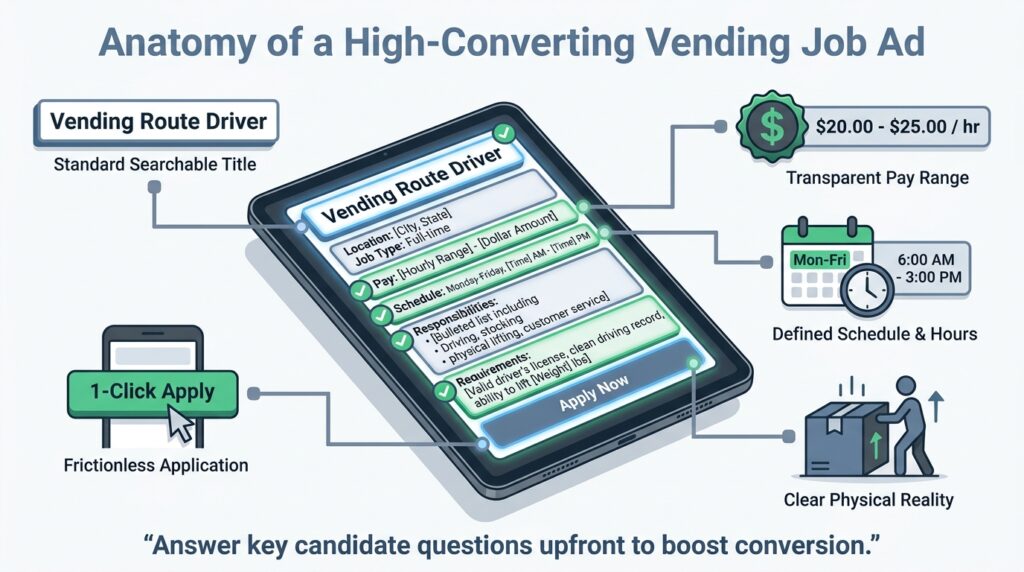
A vending job advertisement should answer the candidate’s most important questions quickly:
| Candidate question | What the job ad should explain |
|---|---|
| What is the job? | Standard job title |
| What will I do? | Day-to-day responsibilities |
| How much will I earn? | Pay or pay range |
| Where will I work? | Route area and location |
| When will I work? | Schedule and expected hours |
| Do I need a vehicle? | Vehicle requirements |
| Is the job physical? | Lifting, walking, loading requirements |
| Do I need experience? | Required vs. preferred experience |
| What do I get? | Benefits and perks |
| How do I apply? | Simple application process |
Indeed specifically recommends including compensation and benefits because candidates use this information to determine whether an opportunity is worth pursuing.
Define the Vending Position Before Advertising
Separate vending roles by responsibilities
Do not use one generic job advertisement for every position.
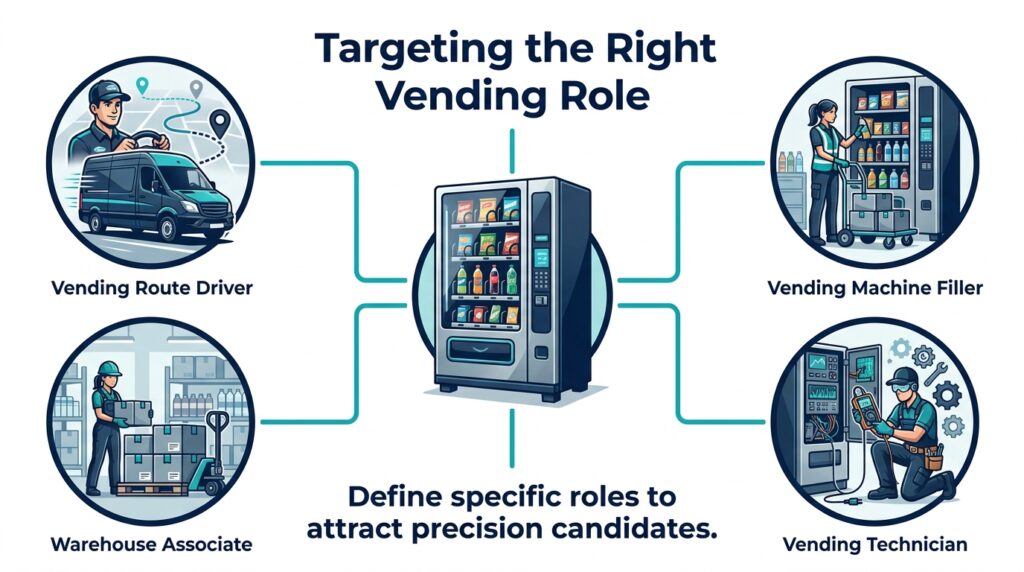
A vending company may need several different employees:
| Role | Primary responsibility | Useful search terms |
|---|---|---|
| Vending machine operator | Manages route and locations | vending operator, vending route operator |
| Vending machine filler | Stocks and rotates products | vending filler, vending stocker |
| Route driver | Delivers inventory and services locations | route driver, delivery driver |
| Vending technician | Repairs and maintains machines | vending technician, field service technician |
| Route manager | Supervises routes and employees | route manager, vending operations manager |
| Warehouse worker | Prepares inventory | warehouse associate, stocker |
The more precisely the role is defined, the easier it becomes to target the right audience.
Vending businesses can also educate candidates about the broader profession by linking to resources explaining what a vending machine operator does and how the industry works.
Use Searchable Job Titles
Use standard titles
Job titles should describe the work in language people actually search. Good examples include:
- Vending Machine Operator
- Vending Route Driver
- Vending Machine Filler
- Vending Route Service Representative
- Vending Machine Technician
- Vending Route Manager
- Vending Stocker
- Route Delivery Driver
Avoid creative titles such as “Snack Experience Specialist” or “Refreshment Rockstar.”They may sound memorable internally but provide little search value externally.Indeed recommends specific, relatable, industry-standard titles because they make roles easier for candidates to understand and find.
LinkedIn similarly recommends searchable job titles rather than flashy titles because standard terminology improves discoverability and candidate matching.
Build a High-Converting Job Description
The first paragraph should qualify the candidate
The opening should immediately explain the role.
For example:
Vending Route Driver — $20–$24/hour
We are hiring a route driver to deliver inventory, restock vending machines, rotate products, and service commercial accounts throughout the Dallas area. This is a field-based position requiring regular driving, lifting, customer interaction, and independent route management.
A candidate should understand the position within seconds.
Indeed recommends a strong opening, precise location information, clear responsibilities, qualifications, salary, and benefits.
Describe the actual day
“Responsible for vending operations” is weak.
“Load products at the warehouse, drive a scheduled route, restock 10–15 machines, rotate inventory, clean equipment, record stock levels, and report mechanical problems” is useful.
Candidates need enough detail to visualize the work.
LinkedIn’s hiring guidance similarly recommends describing day-to-day responsibilities and what success looks like rather than relying on generic requirements.
Separate required and preferred qualifications
A common recruitment mistake is turning every desirable characteristic into a mandatory requirement.
For a route position, required qualifications might include a valid driver’s license, reliable transportation where applicable, ability to lift the required weight, and ability to work independently.
Preferred qualifications might include route delivery experience, vending experience, inventory management experience, or basic mechanical knowledge.
Indeed recommends keeping qualifications concise and distinguishing required qualifications from preferred ones.
Lead With Pay, Schedule, and Job Reality
Salary information improves candidate qualification
Compensation should not be buried at the bottom of the listing.
For context, BLS reported a 2025 national mean wage of $39,540 for stockers and order fillers and $42,260 for laborers and freight, stock, and material movers, hand. Local wages can differ substantially by occupation, metropolitan area, experience, and employer.
A vending employer should benchmark against comparable local jobs rather than blindly copying national figures.
For example:
| Compensation element | Example |
|---|---|
| Hourly pay | $20–$24/hour |
| Schedule | Monday–Friday |
| Hours | 7:00 AM–3:30 PM |
| Overtime | Available when applicable |
| Mileage | Company vehicle or defined reimbursement policy |
| Benefits | Health, PTO, retirement plan |
| Bonus | Performance or route-based bonus if applicable |
Do not advertise bonuses, mileage reimbursement, benefits, or overtime unless they actually apply.
Explain physical requirements
Vending work often involves lifting boxes, loading vehicles, bending, walking, and moving products. A candidate should know this before applying.
BLS reports that hand laborers and material movers commonly perform physically demanding work and that schedules can include nights and weekends. Clear expectations reduce early turnover.
Choose the Right Places to Advertise Vending Jobs
Job boards
Job boards should form the core of many vending recruitment campaigns.
Useful channels can include:
- Indeed
- Local workforce platforms
- Industry-specific employment sites
- Local community job boards
The exact mix depends on the role.
A technician position may perform better on professional or technical platforms, while a route filler may reach more candidates through high-volume general job boards and local community channels.
Google and organic search
A dedicated careers page can capture candidates searching for terms such as:
- vending machine jobs + city
- vending route driver + city
- vending machine operator jobs near me
- vending machine filler jobs
- route service jobs
This is particularly valuable for established vending companies that hire repeatedly. The page should contain the actual job information rather than simply saying “Join our team.”
Local community channels
Vending routes are geographically constrained. A candidate who lives 10 miles from the route may be significantly more valuable than someone 60 miles away. That makes local recruitment powerful.
Consider local Facebook groups, community organizations, workforce centers, vocational programs, neighborhood groups, and local networking channels where permitted. The message should mention the actual service area rather than simply saying “hiring nationwide.”
Use Employee Referrals
Turn existing employees into recruiters
Employees already understand the work and can identify people who would fit the role.
A simple referral program can provide a bonus when a referred candidate is hired and completes a defined retention period.
Referral messaging should focus on the real job:
“Know someone who likes driving, working independently, and staying active? We’re hiring route service employees.”
That message can reach candidates who never search for “vending jobs.”
Create a Strong Candidate Funnel
Track applicants like marketing leads
Recruitment becomes easier to improve when each stage is measured.
| Funnel stage | Metric |
|---|---|
| Job views | Visibility |
| Job clicks | Interest |
| Applications | Conversion |
| Qualified applications | Applicant quality |
| Interviews | Screening effectiveness |
| Offers | Hiring efficiency |
| Accepted offers | Offer competitiveness |
| 30/90-day retention | Hiring quality |
This changes recruitment from guesswork into a measurable acquisition channel.
If 5,000 people see a listing but only 10 apply, the problem may be the job title, compensation, location, requirements, or description.
If 100 people apply but only two are qualified, the problem may be targeting or job-description accuracy.
Test one variable at a time
A vending company can test:
Job title A: Vending Machine Operator
Job title B: Vending Route Driver
Or:
Ad A: $20–$23/hour
Ad B: $22–$25/hour
Or:
Ad A: “Route Driver”
Ad B: “Route Driver — Company Vehicle — Monday–Friday”
Track application quality rather than just application volume.
Pros and Cons of Different Recruitment Channels
Recruitment channel comparison
| Channel | Reach | Cost | Best use |
|---|---|---|---|
| Indeed | High | Free/paid options | Volume hiring |
| High | Free/paid options | Professional and management roles | |
| Company careers page | Long-term | Low after setup | Organic recruitment |
| Social media | Local/high | Low to moderate | Employer branding |
| Employee referrals | Targeted | Referral incentive | Reliable candidates |
| Local groups | Local | Usually low | Route-based positions |
| Workforce organizations | Local | Often low | Entry-level recruitment |
| Direct outreach | Targeted | Labor-intensive | Specialized candidates |
No single channel consistently produces the best candidate for every vending role.
The strongest strategy usually combines job-board visibility + local targeting + employee referrals + an optimized careers page.
Common Vending Job Marketing Mistakes
Using vague job descriptions
“Must be hardworking and reliable” tells candidates almost nothing.
Explain the actual work.
Hiding compensation
Candidates need to know whether the role fits their financial expectations.
Indeed recommends including salary or a salary range and benefits where appropriate.
Using creative job titles
“Vending Rockstar” is memorable but weak for search and candidate matching.
Use the standard title first.
Requiring too much experience
A candidate with delivery, warehouse, retail, or merchandising experience may have the transferable skills required for vending.
Do not reject good applicants simply because they have never operated a vending machine.
Making applications too complicated
A long application can discourage qualified hourly workers.
Start with essential screening information and collect additional information later.
Marketing only on one platform
A route driver may never see your LinkedIn post.
A technician may ignore a local Facebook group.
A warehouse-oriented candidate may search Indeed.
Recruitment works better when the message follows the candidate.
Frequently Asked Questions
What is the best way to market vending machine jobs?
The strongest approach combines searchable job titles, transparent compensation, detailed day-to-day responsibilities, local targeting, major job boards, social media, employee referrals, and an optimized careers page. The objective is qualified applicants, not simply the largest application count.
What should I call a vending machine job?
Use a standard title that matches the actual work, such as Vending Machine Operator, Vending Route Driver, Vending Machine Filler, Vending Route Service Representative, or Vending Technician. Standard titles improve candidate understanding and search visibility.
Where should I advertise vending machine jobs?
Indeed, LinkedIn, local job boards, company career pages, community groups, workforce organizations, and employee referral programs are useful channels. Choose platforms based on the role rather than using the same recruitment channel for every position.
How do I attract candidates to vending machine operator jobs?
Lead with the parts of the role that matter to candidates: pay, schedule, route area, independence, benefits, training, vehicle availability, and advancement opportunities. Then explain the physical and operational requirements honestly.
Do vending machine operators need previous vending experience?
Not necessarily. Candidates from delivery, warehouse, stocking, retail merchandising, logistics, customer service, and field-service backgrounds can have transferable skills. Employers should distinguish genuinely required vending knowledge from skills that can be learned through training.
How much do vending machine employees make?
Vending-specific pay varies by employer and location, so there is no single national salary. As a benchmark, BLS reported 2025 mean annual wages of $39,540 for stockers and order fillers and $42,260 for hand laborers and freight, stock, and material movers.
What should a vending machine filler job description include?
It should explain stocking responsibilities, route locations, schedule, lifting requirements, inventory rotation, machine cleaning, product handling, driving requirements, pay, and required qualifications. The description should reflect the actual workload rather than generic warehouse language.
How can I recruit vending route drivers?
Market the role using related terms such as route driver, delivery driver, route service representative, vending operator, and field service worker. Highlight the service territory, company vehicle policy, schedule, compensation, physical requirements, and amount of driving.
Should vending job postings include salary?
Including a salary range can help candidates quickly determine whether the opportunity fits their expectations. Indeed recommends providing compensation information, while specific salary-disclosure requirements vary by jurisdiction and employer.
How can a vending business reduce employee turnover?
Start by marketing the job accurately. Clear expectations about pay, route size, physical demands, schedule, driving, training, and advancement reduce mismatched hires, while structured onboarding, fair compensation, route support, and measurable performance expectations can improve retention.