
Marketing & Positioning | Personalisation Vending | By the VMarketed Team | September 2026
Every machine we market has the same fundamental problem. The customer already knows what a snack is, what a coffee is, what a bottle of water is. Your job is to make them choose yours, in a category they understand perfectly, against alternatives they can price instantly.
Personalisation machines have the opposite problem, and it is a considerably better one to have. Nobody knows what your machine does, and once they understand it they will stand there for six minutes waiting.
So the entire marketing task collapses into a single objective. Get somebody to understand, in about four seconds from across a room, that this machine will turn a photo on their phone into a real object they can carry home. Everything else follows from that.
Where this comes from: marketing vending operations is our core business. Print on demand machines invert the usual challenge, because the product is genuinely new to most people rather than familiar.
Show the Output, Not the Process
The most common mistake on these machines is explaining how they work before establishing what they make. Three numbered steps about scanning and uploading and selecting mean nothing to somebody who does not yet know what comes out the bottom.
The hierarchy that works, in this order:
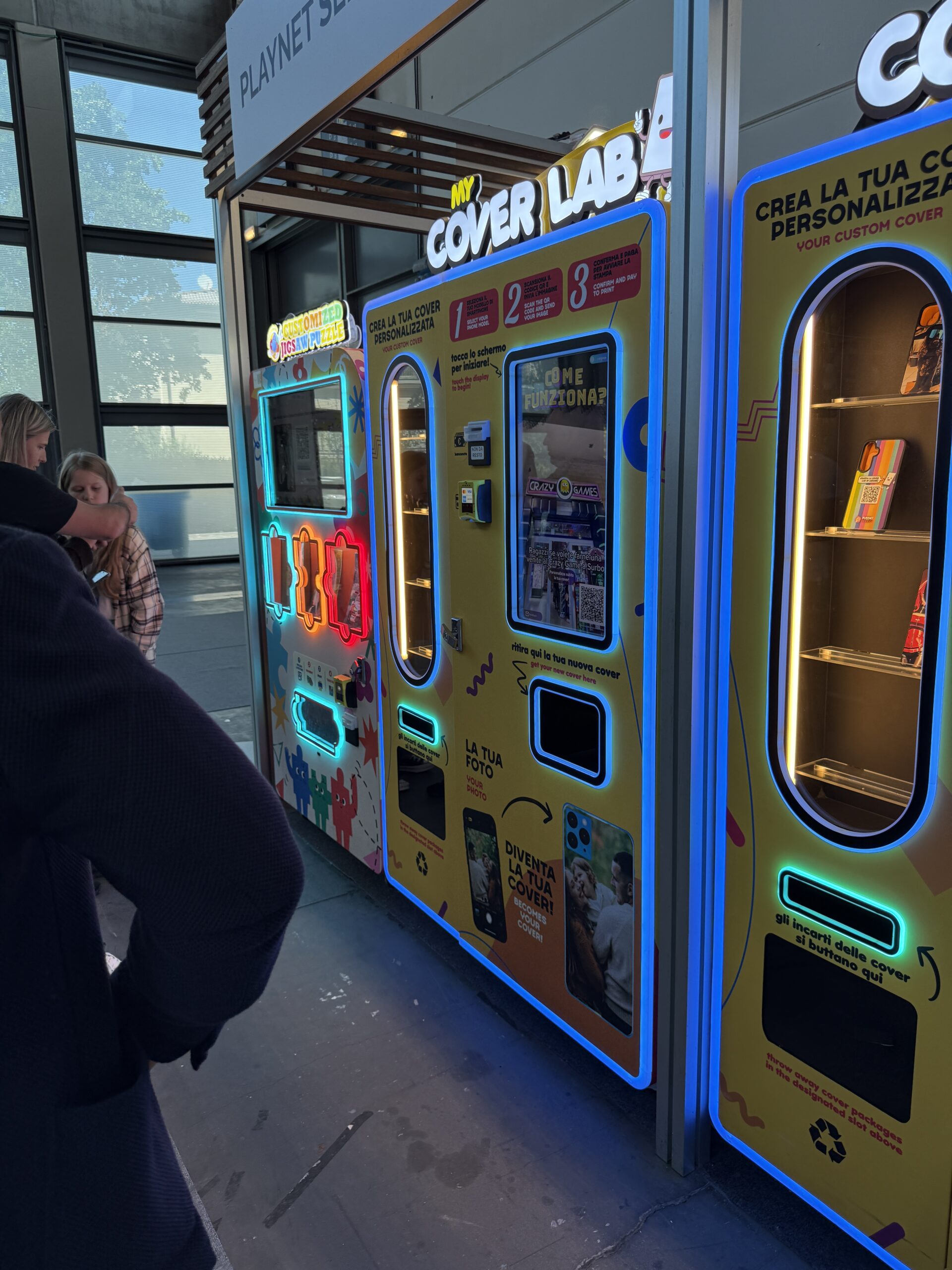
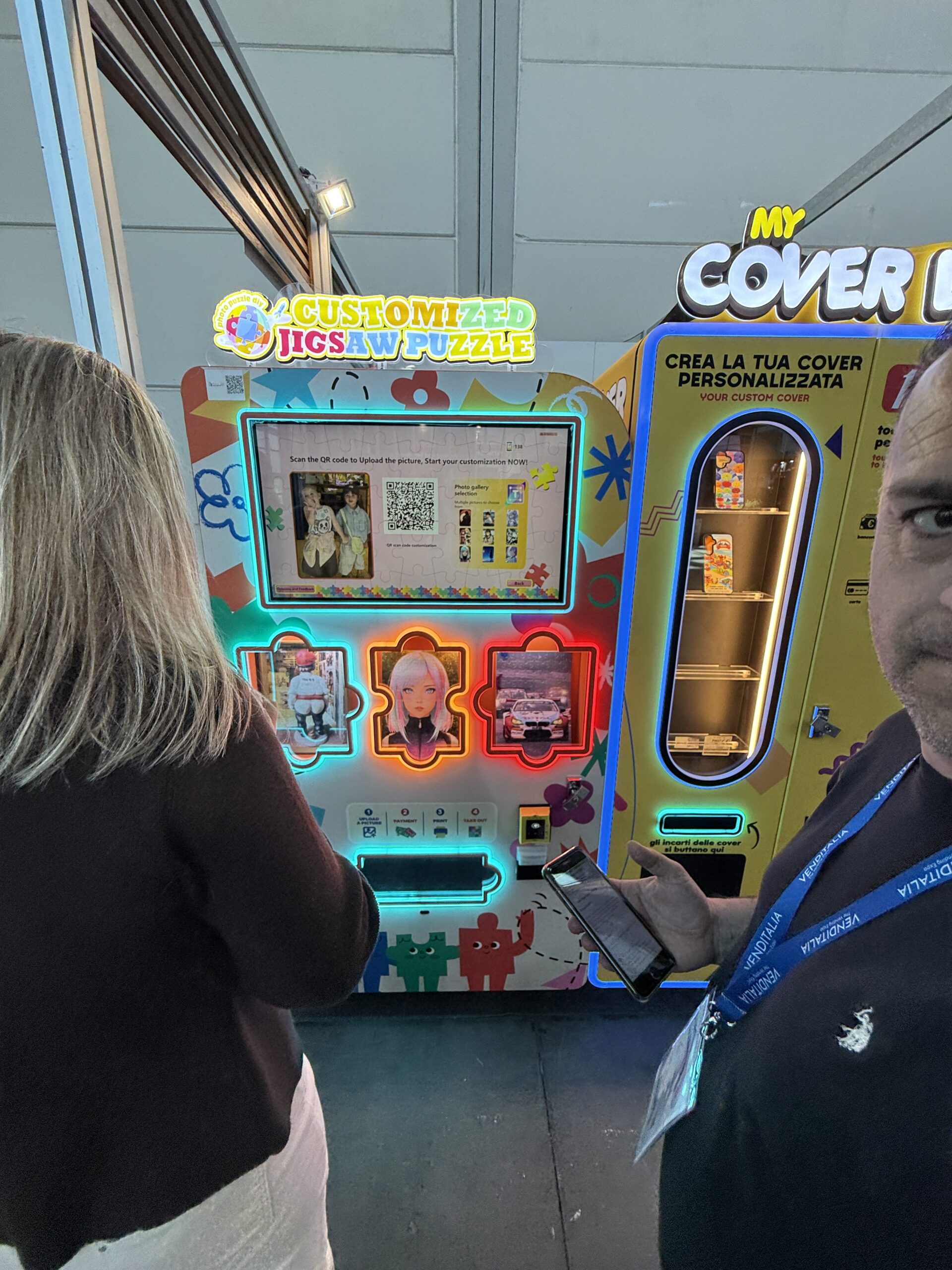
- The finished object, large and obvious. A puzzle with a family photo on it. A case with somebody’s dog. Physical examples behind glass beat any illustration, and the machines in these photographs do exactly that for good reason.
- The idea in four words. Your photo on a puzzle. That is the entire proposition and it does not need improving on.
- Then the process, briefly. Three steps, numbered, small. This is reassurance for somebody already interested, not the thing that creates interest.
- Then the price. Because there is no reference point for a custom object, uncertainty is a real barrier and a clear number removes it.
- Then the wait. Say it plainly. Ready in about five minutes is information somebody needs before starting, and hiding it produces abandoned orders and irritated customers.
Be honest about the wait, prominently. It feels like a weakness and it is not. Somebody who knows it takes five minutes will decide whether they have five minutes. Somebody who finds out after paying feels misled, and that is the single most common complaint in this category. Stating it converts a surprise into a choice.
The Machine Should Look Like an Attraction
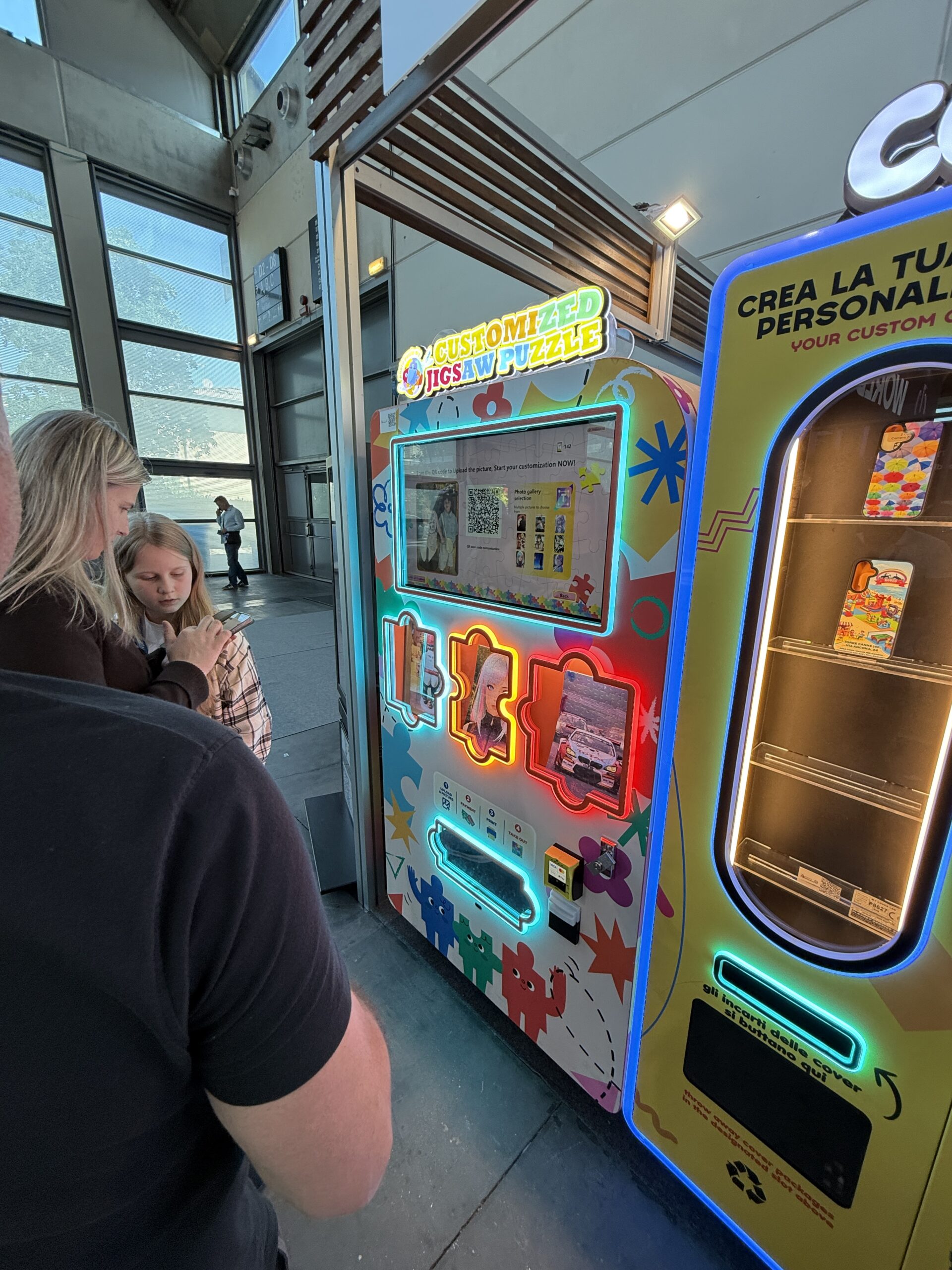
We spend most of our time telling operators to tone machines down. Here we say the opposite, and the photographs above show why.
Bright colour, neon outlining, animated lighting, oversized graphics. On a drinks machine that would read as cheap. On a personalisation machine it reads as an experience, which is exactly what you are selling, because nobody is buying a jigsaw puzzle on price.
- It signals that this is not ordinary vending. The visual difference does the work of an explanation, from a distance, before anybody reads a word.
- It pulls children, who pull parents. At family venues the child is the demand and the parent is the wallet, exactly as with capsule machines.
- It photographs, and these get photographed constantly. A machine that looks like an installation gets posted. A machine that looks like a cabinet does not.
- A bank amplifies all of it. Three lit machines together read as a destination, which is a different proposition from a single unit in the same spot.
Getting that right is a design job rather than a wrap job, and it is what our machine graphics and marketing material service covers. What is physically achievable on the cabinet is worth checking early through VMFS USA custom builds before the design is fixed.
You Are Selling a Memory, So Price Like It
A crucial framing point that operators get wrong by instinct. Compare a personalised puzzle to a puzzle in a shop and it looks expensive. Compare it to a souvenir, a photo print or a gift, and it is competitive while being considerably more personal.
- Never position against the generic version. Your product contains their photograph, which the shop version fundamentally cannot. Inviting that comparison is choosing a fight you do not need.
- Position against the gift shop. At an attraction, the alternative is a branded keyring nobody wanted. Yours is their own day, made into an object. That comparison you win decisively.
- Use gift language. Make it for someone. Take the day home. This is a present, not a purchase, and the words should reflect that.
- There is no price anchor and that is an asset. The object did not exist before they ordered it, so there is nothing to compare against. Do not undermine that by pricing as if there were.
- Offer a range of blanks at different prices. A keyring for the hesitant, a puzzle for the committed. The low priced option converts people who would otherwise walk, and some of them trade up once they understand it.
The Wait Is Marketing Time You Already Own
Every other machine wishes it had a customer’s attention. This one has it for several minutes, guaranteed, with the customer standing still and watching, and almost every operator wastes it entirely on a progress bar.
- Show the printing if you can. A visible mechanism is genuinely watchable and turns a wait into part of the experience rather than a delay.
- Show what else it can make. The single best moment to sell a second product is while somebody is already committed and has nothing else to do.
- Ask them to film it. The reveal moment is inherently shareable. A handle on screen at the right instant costs nothing and earns real reach.
- Set the expectation about quality. If they uploaded a low resolution image, warn them before printing, not after. This prevents the most common complaint in the category.
- Close with something. A code, a reason to come back, a mention of the machine beside it. The moment after a delighted purchase is the most receptive one you will get.
Sell the Occasion, Because the Calendar Does the Work
Most vending demand is flat and weather dependent. Personalisation demand is driven by occasions, which is far more useful because occasions are known months in advance and you can prepare for them.
That gives you a marketing calendar most operators simply do not have:
- Gift occasions. Mother’s Day, Father’s Day, Valentine’s, Christmas. A machine that makes a personalised gift in five minutes is genuinely useful to somebody who has left it late, and that is a message worth putting on the panel for the fortnight beforehand.
- School holidays. Families at attractions with time and children, which is the strongest trading period this format has.
- Graduations and end of term. Enormous on campuses, and the photographs are being taken on the day.
- Peak travel. Airports and hotels, when people have holiday photographs and somebody at home to bring something back for.
- Whatever the venue already runs. An aquarium’s half term programme or a mall’s seasonal event is an audience the venue has assembled for you. Ask what is coming and stock around it.
None of this requires spending money. It requires changing the message on the machine and making sure the right blanks are loaded, which is the cheapest marketing available to an operator and almost nobody does it.
Pitching the Venue
These have an unusually strong pitch if you frame it correctly, because you are not asking for vending space at all.
- You are solving their waiting problem. Queues, lobbies and waiting areas are a venue’s least pleasant asset. A machine that makes waiting enjoyable is an amenity rather than a concession.
- Higher ticket values mean better terms. A personalised product carries several times a snack’s price, so the commission conversation is genuinely more attractive and worth leading with.
- It is not competing with the gift shop. The question every attraction asks. You are selling the visitor’s own photograph, which no gift shop can, and framed that way it complements rather than competes.
- Offer their branding on the product. The strongest move available here. A puzzle carrying both the visitor’s photo and the venue’s logo turns your machine into their marketing, and it costs you nothing.
- Answer the content question first. Every venue worries about what people might print. Raise it before they do, with a real answer on screening, which our partners at VAdviced can help you prepare.
That fourth point is worth pressing. A venue whose logo appears on hundreds of objects people take home and keep is receiving something no other vending arrangement offers, and it frequently moves the conversation from what will you pay us to when can you install it. Put it in a media kit so it survives being forwarded internally, and finding the venues themselves is what VPlaced handles.
Watch Where People Stop, Then Fix It
Because this is a multi step purchase rather than a single button press, people abandon it partway through, and every abandonment is diagnostic. Spend an hour at a live machine and you will learn more than any report gives you.
The four places people quit, and what each one means:
- They look and walk away without scanning. The machine has not communicated what it makes. This is a panel problem and it is the most common failure by a distance.
- They scan, then stop. Usually the price, or the wait, discovered too late. Both belong on the outside of the machine rather than three screens in.
- They browse their photos and give up. Choice paralysis, and a genuine one. Prompting with a suggestion, such as a recent photo, converts noticeably better than an empty picker.
- They reach payment and leave. Either the total surprised them or the payment method did not work. Both are fixable and neither is visible unless somebody is watching.
None of this appears in sales data, because abandoned orders mostly do not register as anything at all. Standing beside the machine for an afternoon in the first fortnight is the highest return activity available in the launch period, and it costs nothing but time.
This Category Is Built for Social
More so than anything else we market in vending, and the reason is structural rather than lucky. The customer made the thing, it contains their own photograph, and they are proud of it. People share what they made far more readily than what they bought.
- Put the handle on the machine and on the screen. At the reveal moment specifically, which is when the phone is already out.
- Reshare everything. Real customers holding real products they made is the most persuasive content available and it arrives free. That runs through social media management.
- Get the venue posting. An aquarium or theme park announcing something new for visitors reaches precisely your audience at no cost.
- Lean into occasions. Mother’s Day, graduations, holidays and school breaks all give people a reason to make something for somebody, which is when this category peaks.
- Be findable afterwards. People search for these machines specifically, so a maintained business profile and a listing on VendingFinder both convert curiosity into visits.
Presentation Is Not Optional Here
One last point that sits between marketing and operations. You are charging a premium for something handmade to order, and the condition of the machine either supports that claim or contradicts it.
- Keep the display samples fresh. Sun faded examples of the product you are selling actively damage the pitch, because the customer assumes theirs will look the same.
- Clean the screen every visit. People touch it constantly and a smeared screen on a premium product is a contradiction they will notice.
- Fix lighting immediately. A dark section on an installation designed around light reads as broken even when the machine works perfectly.
- Never leave a unit out of service in a bank. One dead machine beside two working ones makes the whole installation look neglected, which is worse than having placed two to begin with.
- Refresh the samples with the season. Displaying a holiday themed example in the run up to an occasion does more for conversion than any message you could write.
A Realistic First Ninety Days
| When | What |
|---|---|
| Before install | Output shown large, price and wait time stated, finished samples ready to display |
| Launch week | Venue announcement, someone on site demonstrating, handle on the machine |
| Month one | Watch where people hesitate and fix the panel accordingly, reshare customer posts |
| Month two | Test a lower priced blank, read which products sell at which hours |
| Month three | Occasion campaign, venue co branded product, then use the numbers for the next site |
You can see how we package this on our services page or pick individual pieces from the shop. On the hardware side, screen quality and how much of the output you can display both shape what is marketable, so it is worth starting from the touch screen range or the wider VMFS USA shop.
Frequently Asked Questions
How do you market a personalisation vending machine?
By showing the finished product large and obvious before explaining anything about the process. Most people have never seen one of these, so the machine has to communicate what it makes in about four seconds from across a room. Physical samples on display do this better than any instruction panel.
Should you hide how long it takes?
No, state it prominently. It feels like a weakness and it is not. Someone who knows it takes five minutes decides whether they have five minutes, while somebody who discovers it after paying feels misled. Stating the wait converts a nasty surprise into an informed choice.
How should these be priced?
Against gifts and souvenirs rather than against the generic version of the same object. Your product contains the customer’s own photograph, which a shop bought equivalent cannot, so comparing yourself to it invites a fight you do not need. A range of blanks at different prices also lets hesitant buyers start small.
What is the strongest thing to offer a venue?
Their branding on the product alongside the customer’s photograph. A venue whose logo ends up on hundreds of objects people take home and keep is getting something no other vending arrangement can offer, and it costs you nothing to include.
Make People Understand It in Four Seconds
We design the panel hierarchy, the screen experience and the venue pitch for a format most people have never seen before. Tell us what you are printing and where.