How to Market a Pokémon Vending Machine to Attract More Buyers
You market a Pokémon vending machine by combining a high-traffic, collector-friendly location with visible signage, live-pull touchscreen demos, timed drops around new set releases, and local digital promotion — because Pokémon TCG buyers respond to visible proof of pulls, freshness, and convenience more than to discounts. Operators who pair the right venue with the right promotion cycle regularly report gross revenue of $2,400 to $7,200 per month per machine, with the strongest sites spiking well beyond that during major set launches.
Pokémon card demand hasn’t slowed down. Spending on Pokémon and other non-sports trading cards jumped 350% between 2020 and 2025, according to market research firm Circana, and the category shows no sign of cooling as the franchise moves through its 30th-anniversary product cycle. That growth is exactly why marketing — not just placement — now decides which machines pull steady profit and which ones sit ignored in a corner.
Why Marketing Matters More Than the Machine Itself
A Pokémon vending machine does not sell itself just because it is stocked with sealed product. Revenue swings dramatically based on visibility and promotion — the same machine model placed in a busy mall corridor can generate tens of thousands of dollars a month, while the identical unit tucked into a quiet office lobby might barely cover restocking costs, according to placement data from Digital Media Vending’s operator research. Marketing closes that gap because it converts passive foot traffic into paying customers who might otherwise walk past without noticing the machine.
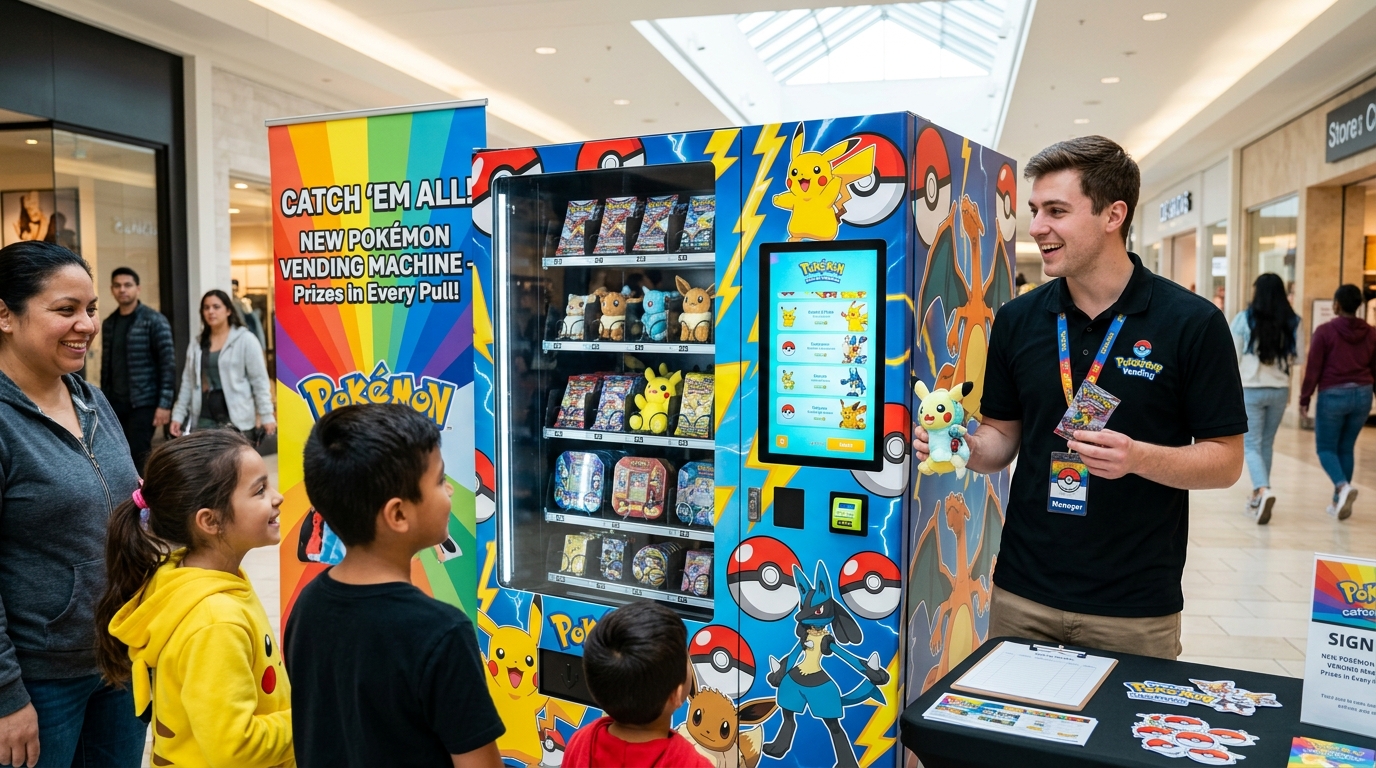
Buyers respond because collecting Pokémon cards is driven by “pull culture” — the visible, shareable moment of opening a pack and revealing a rare card. Machines that make this moment visible, through screens, signage, or social proof, out-earn machines that simply display product behind glass. Understanding how Pokémon vending machines work mechanically is the starting point, but marketing is what turns that mechanism into repeat business.
Choose a Location That Sells Itself
Location is the single biggest driver of marketing performance because it pre-qualifies your audience before you spend a dollar on promotion. A vending machine placed among collectors requires far less marketing effort than one placed among people who have no interest in trading cards.
Prioritize Collector-Dense Venues
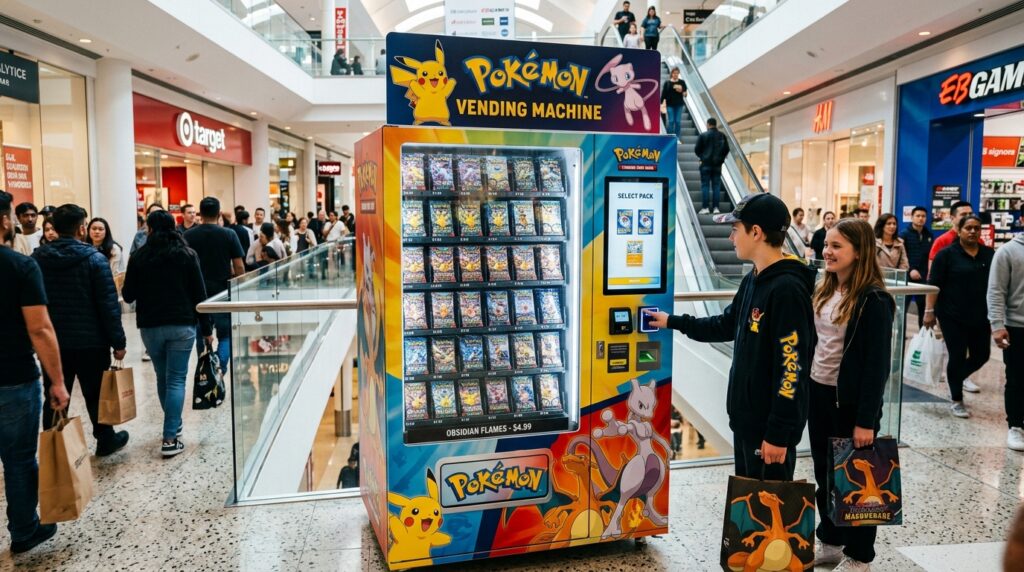
The strongest locations combine two things: high foot traffic and a demographic already primed to buy trading cards. Shopping malls, family entertainment centers, arcades, hobby and comic shops, laundromats near residential areas, and barbershops consistently outperform generic office lobbies. Grocery store lobbies work too, but The Pokémon Company International has already saturated much of that channel — it now operates roughly 1,473 official vending machines across 25 states and Washington D.C., up from just 65 in 2023, making independent placement in that specific channel more competitive. Review the full best places for Pokémon vending machine placement guide before signing any location agreement.
Audit Foot Traffic Before You Commit
Visit a shortlisted venue at three different times — weekday afternoon, weekend, and evening — before signing anything. A location that looks busy at noon can be dead by 6 p.m., and Pokémon buyers skew toward after-school and weekend hours. Run through a placement checklist so you don’t sign a lease based on a single good visit; this pre-placement checklist covers the traffic, security, and contract questions worth asking upfront.
Let a Matching Service Do the Legwork
Cold-pitching venue managers is slow and often ends in silence. Location-matching platforms connect vetted operators with venue owners actively looking to host vending equipment, cutting weeks off the search.
Have retail space and want a Pokémon vending machine placed for free? List your location, get matched with a qualified operator, and start earning revenue-share income with zero setup cost on your end.
If you’re an operator hunting locations rather than a property owner, the reverse search works too — this guide to finding existing Pokémon vending machines near you doubles as a competitive scouting tool, showing where saturation already exists so you can target underserved neighborhoods instead. You can also browse current Pokémon vending machine locations to benchmark venue types against your own shortlist.
Build Signage and Branding That Convert Foot Traffic
Signage is the first marketing touchpoint most buyers see, and it has to work in under three seconds — the average time a passerby glances at a vending unit before deciding whether to stop. Bright, high-contrast wraps with clear pricing and a visible “Pokémon Trading Cards” label outperform generic vending graphics because they immediately answer what the machine sells.
Brand the Machine, Not Pokémon’s IP
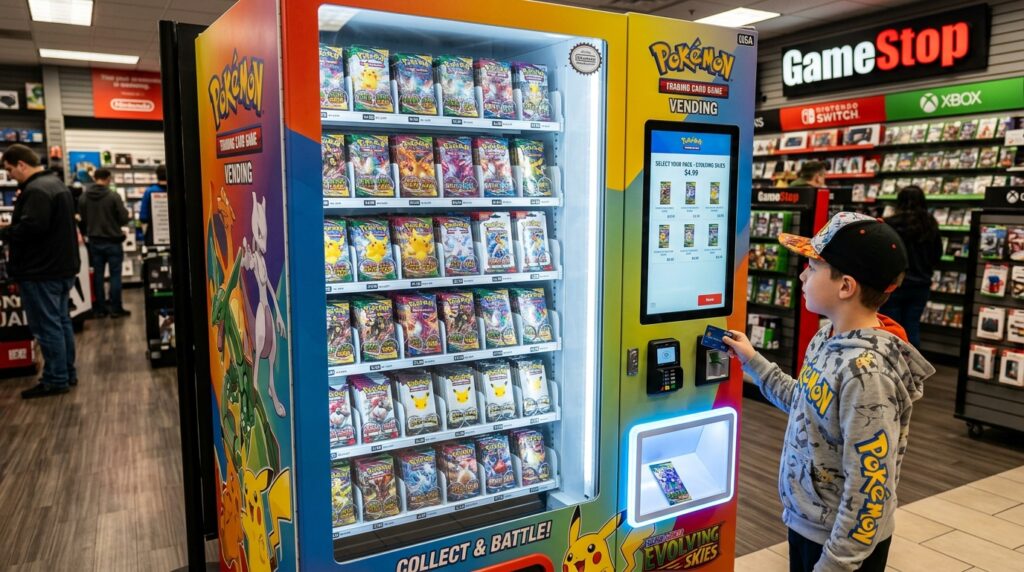
One critical rule shapes every design decision here: independent operators cannot legally put the Pokémon logo, Pikachu artwork, or any registered Pokémon trademark on a machine wrap without a license from The Pokémon Company International. Doing so is trademark infringement, and it also risks implying a false partnership, which is a separate legal problem on top of the IP issue. Machines wrapped this way have been flagged in operator legal reviews as a liability rather than an asset — see the detailed breakdown in can you use the Pokémon logo on a TCG vending machine. The workaround is straightforward: build your own brand identity — a name, a color palette, a mascot — and let the sealed product visible through the machine’s window do the visual selling of “Pokémon” for you.
Use the Touchscreen as a Marketing Asset
Modern TCG vending machines include touchscreen displays capable of showing live card-pull footage, current stock, and pricing. Operators who run rotating “recent pulls” content on the screen see higher impulse conversion than machines that show static product images, because the screen recreates the excitement of pack-opening content that already drives Pokémon’s social media engagement. Pair this with clear, non-infringing signage that states pricing upfront — hidden or unclear pricing is one of the fastest ways to lose a hesitant buyer at the machine.
Time Your Restocks and Drops Around Demand
Demand for Pokémon product is not flat throughout the year — it spikes hard around new set releases, and marketing that ignores this cycle leaves revenue on the table. The newest set on a machine consistently outsells every older product by a wide margin; in one documented 28-day case study, the newest releases drove 74% of total machine revenue while four older sets combined for less than 15%.
Plan Inventory Four to Six Weeks Ahead
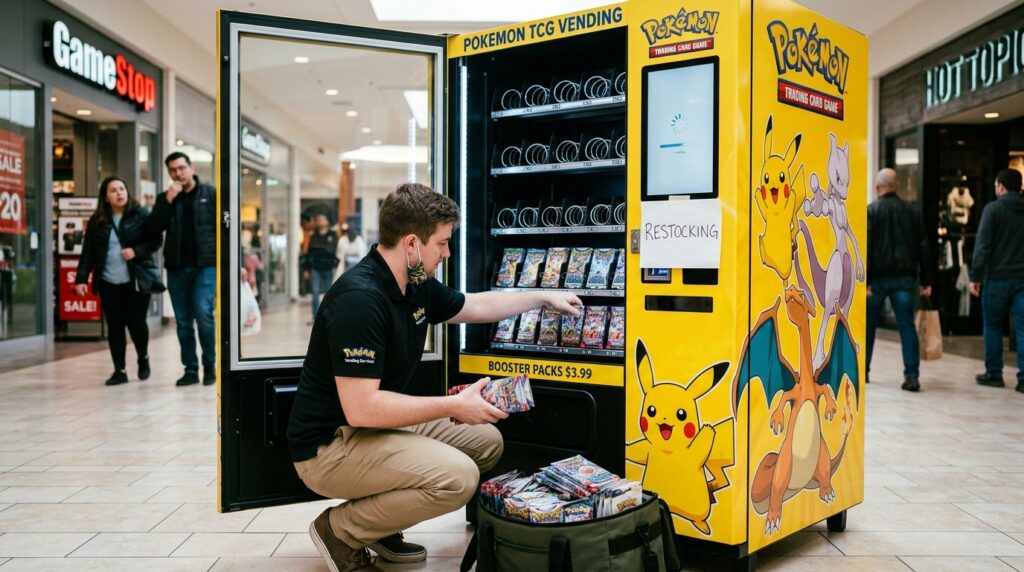
Because new-set demand is so front-loaded, operators need product in hand and visible in the machine on release day, not a week after. Planning restocks four to six weeks ahead of each major set launch avoids the stock-out window when hype — and search traffic — is at its peak. A documented Pokémon vending machine restock schedule also signals reliability to repeat buyers, who learn when to check back.
Market the Restock Itself
A restock is a marketing event, not just a logistics task. Announce it — through a simple sign, a social post if the location has a page, or a note on the touchscreen — so returning buyers know fresh product is available. Machines that treat restocking as silent maintenance miss the chance to re-engage lapsed buyers who assumed the machine was sold out.
Data point worth planning around: Two-thirds of vends at one documented gas-station location happened between 6 p.m. and 6 a.m. — hours when hobby shops and official retail are closed. If your venue operates 24 hours, that after-dark window is where a Pokémon vending machine earns its keep over traditional retail competitors.
Promote the Machine Online and Hyperlocally
Digital promotion for a physical vending machine works best when it is hyperlocal — you are not trying to reach a national audience, you’re trying to reach the few thousand people who live or work within a short drive of the machine.
Claim Local Search and Maps Listings
List the machine’s venue on Google Business Profile with photos, hours, and a description mentioning “Pokémon trading cards” and “TCG vending machine.” Local collectors regularly search phrases like “Pokémon vending machine near me,” and an unclaimed or missing listing means that search traffic goes to a competitor’s machine instead. Cross-check saturation in your metro area using resources like this guide to finding a Kroger Pokémon vending machine to understand where official retail already covers demand, so your independent listing targets the gap.
Use Community and Collector Groups
Local Facebook groups, Discord servers, and subreddits built around Pokémon collecting or regional trading card communities are high-intent audiences. A single well-placed post announcing a new machine location, or a restock of a hot set, tends to outperform paid social ads aimed at a broad, untargeted audience — because the people in these groups are already actively buying.
Encourage User-Generated Pull Content
When a buyer pulls something valuable, a simple prompt near the machine — “tag us in your pulls” — turns that customer into free marketing. This mirrors the pack-opening content that already drives massive engagement across Pokémon collector social media, without requiring the operator to touch any trademarked branding directly.
In-Store Tactics That Increase Impulse Buys
Once foot traffic and awareness bring a buyer within sight of the machine, a handful of in-store tactics measurably raise the odds of a purchase.
Keep the Product Mix Visible and Fresh
A cluttered or half-empty machine reads as neglected and discourages purchases. Rotate older, slower-moving sets out and keep the newest release front and center, ideally in the first or most visible slot. Understanding the physical components of a Pokémon vending machine — dispensing mechanism, card-safe channels, touchscreen — helps operators diagnose when a jam or display glitch is quietly costing sales.
Price for Impulse, Not Just Margin
Buyers at a vending machine are making a faster decision than buyers in a card shop. Keeping individual pack prices in a clear, round, easy-to-process range reduces hesitation at the point of sale. Reference current Pokémon vending machine pricing benchmarks when setting your own vend prices so you stay competitive without eroding margin.
Reduce Friction at the Machine
Cashless payment, a responsive touchscreen, and clear on-screen instructions matter more than most operators expect — a confused first-time buyer often walks away rather than asking for help. If buyers are unsure how the process works, a simple printed “how to use this machine” panel solves it; see how to use a Pokémon vending machine for the standard flow to model your instructions on. Machines that go dark or freeze also kill sales instantly — keep a fix on hand for the common black screen issue so downtime doesn’t undercut your marketing spend.
Stay Legally Compliant While You Market
Marketing tactics that skirt trademark or licensing rules can undo months of legitimate growth in a single cease-and-desist letter. Operators can legally sell genuine, factory-sealed Pokémon product under the First Sale Doctrine, but they cannot use Pokémon’s brand assets to sell it, and they cannot imply official partnership or endorsement.
Avoid False Affiliation Claims
Calling a machine an “Official Pokémon Vending Machine” or an “Authorized Pokémon Retailer” is both trademark infringement and consumer fraud when no such relationship exists. Marketing copy, social posts, and signage should describe the machine by what it does — sells sealed Pokémon TCG product — without borrowing Pokémon’s brand language to do it. The full legal position, including what is and is not permitted, is covered in can you legally sell Pokémon in a vending machine.
Formalize the Location Relationship
A verbal handshake with a venue manager is not a marketing asset — a written placement agreement is, because it protects the revenue-share terms, service access, and liability coverage that let you invest confidently in signage and promotion for that location. Review a standard Pokémon vending machine placement agreement before finalizing any new site.
Get the Business Structure Right First
Marketing spend is wasted if the underlying business isn’t structured to protect the operator from liability or positioned correctly for tax purposes. Most independent operators choose an LLC for the liability separation it provides between personal assets and the vending business, paired with proper sales tax registration in each state where machines are placed. Before scaling marketing across multiple locations, confirm your entity structure is set up correctly:
Setting up an LLC, structuring sales tax registration, or drafting location and vendor contracts before you scale your vending route? Get the legal foundation right the first time.Form an LLC for Your Vending Business
Operators weighing other structures can compare a sole proprietorship, a partnership for a vending machine business, or an S-Corporation depending on how many locations and partners are involved, and should also look into naming a registered agent for a vending machine business as part of state registration.
Pros and Cons of Aggressive Marketing Tactics
Pros of Investing in Marketing
Strong signage, timed drops, and local promotion measurably increase revenue per machine, reduce dead stock from slow-moving sets, and build repeat-buyer loyalty that survives price competition from nearby retail.
Cons and Risks to Manage
Aggressive promotion around mystery or blind-box formats risks venue pushback — one mystery-box machine was reportedly removed from a high-security federal location within days of drawing scrutiny. Overusing Pokémon’s branded imagery in marketing materials also creates direct trademark exposure.
Marketing Channel Comparison Table
| Marketing Channel | Cost | Best For | Typical Impact |
|---|---|---|---|
| On-machine signage and wraps | Low, one-time | New locations, first impressions | High — first three seconds of buyer decision |
| Touchscreen pull-video content | Low, ongoing | Impulse conversion at the machine | Medium-High |
| Google Business Profile listing | Free | Local search visibility | Medium, compounds over time |
| Community groups (Discord, Facebook) | Free | Restock announcements | High, for engaged local collectors |
| Restock timing around set releases | Inventory planning cost only | Maximizing per-set revenue | Very High |
| Paid local social ads | Moderate, ongoing | New or low-awareness venues | Low-Medium relative to cost |
Common Marketing Mistakes to Avoid
Most underperforming Pokémon vending machines fail for a small, repeatable set of reasons rather than bad luck. Letting the newest set sell out and sit empty for days kills the exact demand spike that drives most of a machine’s monthly revenue. Using Pokémon’s trademarked logo or characters on the machine wrap invites legal risk that can shut a location down entirely. Choosing a location purely on rent price rather than buyer demographics wastes marketing spend on an audience that was never going to convert. And neglecting basic maintenance — jams, blacked-out screens, payment failures — undoes marketing gains the moment a buyer walks up to a machine that doesn’t work; a documented maintenance schedule and knowing how to reset the machine when it glitches prevent this from becoming a recurring problem. For a full pre-launch and ongoing operational checklist, see how to do Pokémon vending machine maintenance.
Getting the fundamentals right from day one also matters — a well-sourced, well-placed machine markets itself far more easily than one fighting uphill against a bad launch. Review the complete how to start and operate a Pokémon vending machine guide and the complete 2026 operator guide for the full operational picture before your first launch.
Ready to Put a Machine Where Buyers Already Are?
Marketing works far better when the hardware behind it is reliable, card-safe, and easy to stock. Operators sourcing their first or next unit can compare current pricing and review where to buy a Pokémon vending machine before committing. VMFS USA, a vending machine company in the USA, supplies operator-ready trading card vending equipment built for exactly this use case.
Get a Pokémon card vending machine built for high-security, card-safe dispensing — ready to stock, brand, and place in your highest-traffic location.
Looking for a different footprint? Compare the compact TCG vending machine against the large Pokémon vending machine depending on your venue’s space and expected volume.