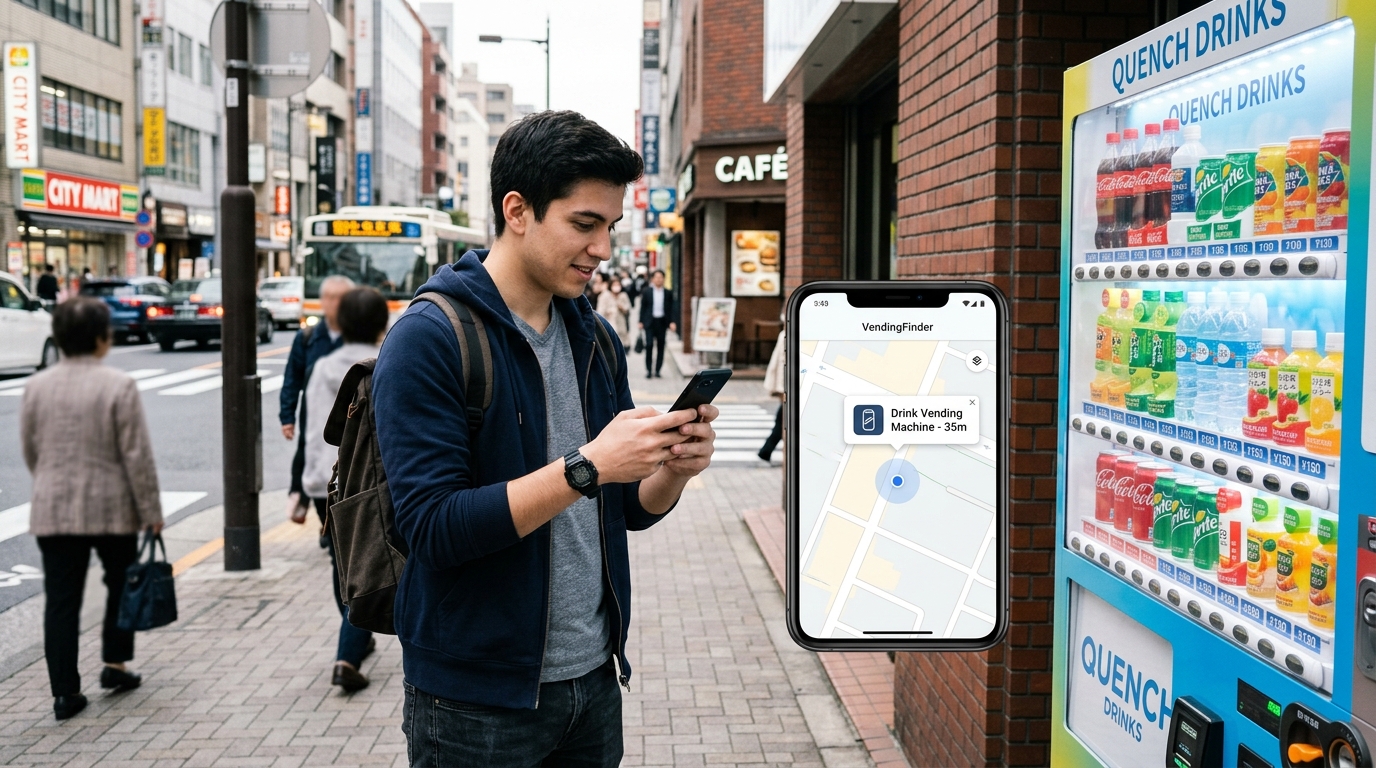
How to Find Drink Vending Machines Near You
Finding a drink vending machine near you is harder than finding a coffee shop or gas station because vending machines aren’t a recognized place category on Google Maps, which means the app that answers almost every other “near me” question can’t reliably answer this one. This guide covers the methods that actually work, from purpose-built locator apps to the building-directory tricks most people never think to try, plus what to do when the honest answer is that there isn’t one nearby yet.
Quick takeaways
Google’s official Places API has no “vending machine” category, so map searches return inconsistent results by design, not by accident.
Dedicated vending locator apps and directories fill that gap with crowd-verified or business-submitted listings.
Building front desks, property managers, and campus apps are often faster and more accurate than any app for a specific known building.
If there’s genuinely no machine nearby, requesting one or listing the space is usually free for the property owner.
Why “Vending Machine Near Me” Searches Behave Differently
A “vending machine near me” search behaves differently than a restaurant or pharmacy search because vending machines have no dedicated place category in Google’s mapping infrastructure. Google’s official Places API type list runs to well over 200 categories, covering everything from cat_cafe to ferris_wheel, according to Google’s own Places Insights place type reference, yet none of them is “vending machine.” Users have raised this gap directly with Google, requesting a dedicated vending machine place type in a Google Maps Community feature request thread, confirming this is a known, unresolved limitation rather than a search-technique problem on the user’s end.
Because there’s no structured category, a machine only shows up on Google or Apple Maps if a business owner manually tags it, or if enough people mention it in reviews for the algorithm to associate it with the pin. Most standalone vending machines in a hallway, break room, or lobby never get that manual tagging, which is exactly why dedicated tools exist to fill the gap.
This is also why a search that works perfectly for “coffee shop near me” can return nothing useful for “vending machine near me” even in a dense downtown core full of office buildings. A coffee shop is a standalone business with its own listing, its own hours, and its own reviews driving the algorithm. A vending machine is almost always a piece of equipment inside someone else’s business, tucked into a lobby or break room that the building itself never bothered to describe in those terms. The machine exists physically, but it has no independent digital footprint unless a person or a purpose-built tool creates one.
Best Ways to Find a Drink Vending Machine Near You
Dedicated Vending Machine Locator Apps
Purpose-built locator apps solve the categorization problem directly by letting users or operators submit machine locations to a dedicated map rather than relying on Google’s generic business listings. Crowd-sourced apps such as VendMap let users drop a pin, rate the machine, and report issues like out-of-stock items, functioning as a community-verified map layer that Google Maps doesn’t offer on its own. Directory-style tools like Vending Machine Finder take a different approach, letting users search by city, state, or ZIP code and filter by category, from snacks and coffee to more specialized formats like trading card or vape machines. Both approaches trade some coverage gaps, since neither has mapped every machine nationwide, for far higher accuracy on the machines they do include.
Google Maps and Apple Maps (and Their Limits)
General mapping apps are still worth trying first because they’re already installed and searchable by voice, but set expectations accordingly. A search for “vending machine” on Google or Apple Maps will surface machines that happen to be tagged inside a business listing, such as a hotel or laundromat that mentions vending in its description, while missing standalone machines in office lobbies, apartment complexes, or transit corridors that no one has manually logged. Treat a map search as a first pass rather than a definitive answer, and cross-check with a dedicated locator app if the first search comes up empty.
Building Directories, Front Desks, and Property Management
For a specific known building, whether it’s a workplace, apartment complex, or hospital, the fastest and most reliable method is often the least technical one: ask the front desk, check the building directory near the elevators, or call property management directly. This works because building staff have direct knowledge that no app can replicate, and most office buildings, medical centers, and apartment complexes that have a machine will list its floor or wing on a lobby directory.
Campus, Transit, and Venue-Specific Apps
Universities, hospital systems, and transit authorities increasingly run their own facilities apps that map amenities, including vending machines, more precisely than any third-party tool could. A university’s official campus app, for instance, typically pulls from facilities-management data rather than crowd submissions, which makes it more current than a general locator app for that specific property. The same logic applies to major transit hubs and stadiums, where the venue’s own app usually beats a generic search.
Social Media, Reviews, and Word of Mouth
Local Facebook groups, neighborhood forums, and even a quick search on Reddit for a specific city or campus often surface machines that no locator app has indexed yet, because residents and regulars mention them in passing when discussing a building or neighborhood. Review platforms work the same way indirectly: a hotel, laundromat, or gym listing with “vending machine” mentioned in a handful of reviews is a reliable signal even without a dedicated category, since real visitors are describing what they actually saw. This method is slower than a purpose-built app, but it fills in gaps in newer or smaller buildings that haven’t been crowd-mapped yet.
Thinking About Adding a Machine Instead of Searching for One?
Browse ready-to-ship drink vending machines or configure a custom unit for your space.
Comparing the Main Methods
No single method covers every situation, so matching the tool to the setting saves the most time. The table below breaks down how each approach performs on coverage and accuracy.
Locator Apps: Pros
Purpose-built for exactly this search, unlike general mapping apps.
Filterable by machine type, and often by payment method.
Useful for unfamiliar cities and travel.
Asking On-Site: Pros
Zero app installs or account setup required.
Staff know about machines that never made it onto any app.
Most accurate for a single specific building you’re already in.
What to Do When There’s No Vending Machine Nearby
Requesting One for Your Office or Building
If a search comes up empty because the location genuinely doesn’t have a machine, the fix is usually simpler than people expect. Most office buildings and workplaces can request a machine through facilities management or HR, and the request costs the organization nothing in most cases since vending operators typically install and stock machines at no upfront cost in exchange for a small commission on sales. Our guide to drink vending machines for offices covers the cost, capacity, and compliance details worth knowing before making that request.
How Free Placement Works
Free placement means a vending operator supplies, installs, and services the machine, earning revenue from sales rather than charging the property owner anything upfront. Most managed vending providers look for a minimum headcount, commonly in the 40-to-50-employee range for an office, before agreeing to free placement, since that’s roughly the point at which projected sales justify the investment. Below that threshold, or for locations with unpredictable traffic, listing the space with a placement network is usually faster than contacting individual operators one by one.
No Machine at Your Office Yet?
List your space and get matched with a qualified operator who handles supply, stocking, and service.
List Your Location for Free PlacementFinding Locations to Place Your Own Vending Machine
“Finding vending machines near you” also describes a second, entirely different search: entrepreneurs and small operators scouting for places to install their own equipment rather than looking for a drink. If that’s the actual goal, the search strategy flips from locating existing machines to identifying underserved buildings that would benefit from one.
Site-Scouting Criteria That Matter
A promising site combines steady foot traffic with the absence of an existing machine or nearby alternative, since duplicating a spot that already has vending rarely pays off. Manufacturing sites and offices remain the two largest vending placement categories nationally, together accounting for well over half of all machine installations, which makes commercial and industrial buildings the highest-probability starting point for a site search. Before approaching any location, confirm it has the physical space and electrical access a machine needs; our drink vending machine dimensions guide covers the footprint requirements to check before pitching a property manager.
Headcount and shift patterns matter as much as raw traffic. A warehouse running two or three shifts effectively multiplies its usable population beyond the daytime headcount alone, since a machine there sees demand around the clock rather than compressed into a single lunch window. Distance from the nearest retail alternative is worth walking, not just estimating: a location a five-minute drive from the closest gas station or convenience store performs meaningfully better than one across the street from a 24-hour pharmacy, because the vending machine has to win on convenience, not price, to capture the sale.
Working With a Placement Network Instead of Cold-Calling
Cold-calling property managers one building at a time is slow and has a low hit rate, since most calls reach someone without authority to approve equipment installations. A placement network flips that process by having property owners and facilities managers list their own space when they want vending, which means every listing already comes with an interested decision-maker attached rather than a cold lead. Our detailed breakdown of where drink vending machines perform best across facility types goes deeper into which categories of building convert into the strongest locations.
What Makes a Location Worth Approaching
Foot traffic alone doesn’t guarantee a good vending location; the traffic has to also lack a convenient alternative. A lobby a few doors from a convenience store rarely performs as well as an office break room with no nearby retail at all, because vending sales depend on capturing demand that would otherwise go unmet rather than demand already served elsewhere. Headcount matters too: for an office setting specifically, our guide on where to place a drink vending machine inside an office walks through the specific spots, from break rooms to elevator corridors, that convert best once a location has agreed to host a machine, and our capacity guide helps size the right unit to that headcount before the first delivery.
Decision-maker access is the final filter, and it’s the one most new operators underweight. A large corporate office might have hundreds of employees walking past a proposed spot every day, but if the lease prohibits added equipment without corporate real estate sign-off, that traffic is inaccessible until someone with authority approves it. A smaller, independently owned business with a fraction of the foot traffic but a single decision-maker who can say yes on the spot often converts into a working location faster and with less friction than a technically higher-traffic site buried in corporate approval layers.
Business Considerations for Vending Machine Operators
Securing a location is only the first step; operating machines across multiple sites is a small business in its own right, and it’s worth structuring accordingly from the start. Forming an LLC before signing a location agreement protects personal assets from liability tied to a specific site, whether that’s a product-related claim or an injury near the machine, and it establishes a clean entity for the revenue-sharing terms most property owners expect in a location contract.
Beyond the entity itself, an EIN and, in most states, a sales tax registration are the two pieces of paperwork that tend to trip up new operators, since vending sales are taxable retail transactions in the large majority of jurisdictions even though the buyer never interacts with a cashier. Getting both in place before the first machine goes live, rather than retrofitting compliance after sales have already started, avoids the scramble that comes with a state tax notice arriving mid-year.
Ready to formalize your vending operation?
Set up the entity and liability protection before signing your first location agreement.
Form an LLC for a Vending Machine BusinessChoosing the Right Machine Once You Have a Location
Once a location is confirmed, whether it’s your own office requesting a machine or a site you’ve secured as an operator, matching the machine to the space matters more than picking the most feature-rich model available. Cashless payment is no longer optional either way: over 60% of new vending machines now ship with card readers as standard, and unattended, self-service retail formats broadly are seeing strong consumer preference, with 84% of U.S. consumers favoring self-service options over staffed alternatives in recent industry research from PYMNTS Intelligence’s unattended retail report. Budget and full pricing breakdowns by machine type are covered in our drink vending machine pricing guide, and once the machine is installed, our walkthrough on how to use a drink vending machine is worth sharing with first-time users, while our guide on freeing a stuck drink heads off the most common day-one complaint.
Explore Machines by Location Type
Five configurations covering dedicated drink service, combo formats, and higher-volume routes.
Frequently Asked Questions