Drink Vending Machine Marketing Strategies That Actually Increase Sales
The most effective drink vending machine marketing strategies combine three levers: reduce friction at the point of sale, make the machine itself a promotional surface, and use purchase data to keep the product mix aligned with real demand. Cashless payment alone drives measurable results, cashless transactions accounted for roughly 71 percent of U.S. vending sales in 2024, up 17 percentage points year over year, and cashless customers spend 37 percent more per transaction than cash buyers, according to industry sales data compiled from operator reporting (2026 vending industry statistics). This guide covers the specific tactics operators use to convert an ordinary machine into a location’s highest-margin retail footprint, from wraps and QR-triggered promotions to loyalty programs, local search visibility, and data-driven merchandising.
Table of Contents
- What Actually Moves Vending Sales
- Machine-Level Marketing: Turning the Cabinet Into a Storefront
- Payment Friction as a Marketing Lever
- Loyalty Programs and Repeat-Purchase Marketing
- Local and Location-Based Marketing
- Social Media and Content Marketing for Vending Routes
- Data-Driven Merchandising as a Marketing Tool
- Marketing Tactics Compared
- Seasonal and Event-Based Promotions
- Common Marketing Mistakes
- Key Takeaways
What Actually Moves Vending Sales
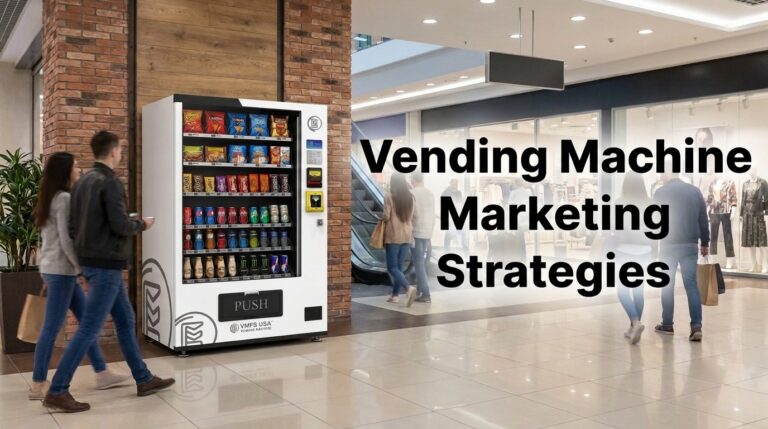
Vending sales respond most directly to three factors: how easy the machine is to pay at, how clearly it communicates what is inside and why to buy it, and how well the product mix matches what people at that specific location actually want. Cashless payment removes the single biggest point of friction in an impulse purchase, which is why the shift toward tap-to-pay and mobile wallets correlates so strongly with higher transaction values industry-wide. Visual merchandising, wraps, signage, and clear calls to action at the payment point, works because a vending machine functions as a miniature storefront window, and shoppers make a buy decision in the few seconds they stand in front of it.
Data completes the loop. Every cashless transaction generates a record of what sold, when, and at what price point, and operators who act on that data by adjusting SKUs, running targeted promotions, or catching a stuck-product complaint before it becomes a lost customer consistently outperform operators running the same machine on guesswork. Getting the fundamentals right, correct drink vending machine capacity for the site’s traffic and a location matched to your product mix, is the foundation every marketing tactic below builds on.
Machine-Level Marketing: Turning the Cabinet Into a Storefront
The machine itself is the highest-leverage marketing asset an operator controls directly, since it is the one surface every customer sees before they buy. Three elements determine whether that surface converts a passing glance into a sale.
Wraps, Branding, and Visual Merchandising
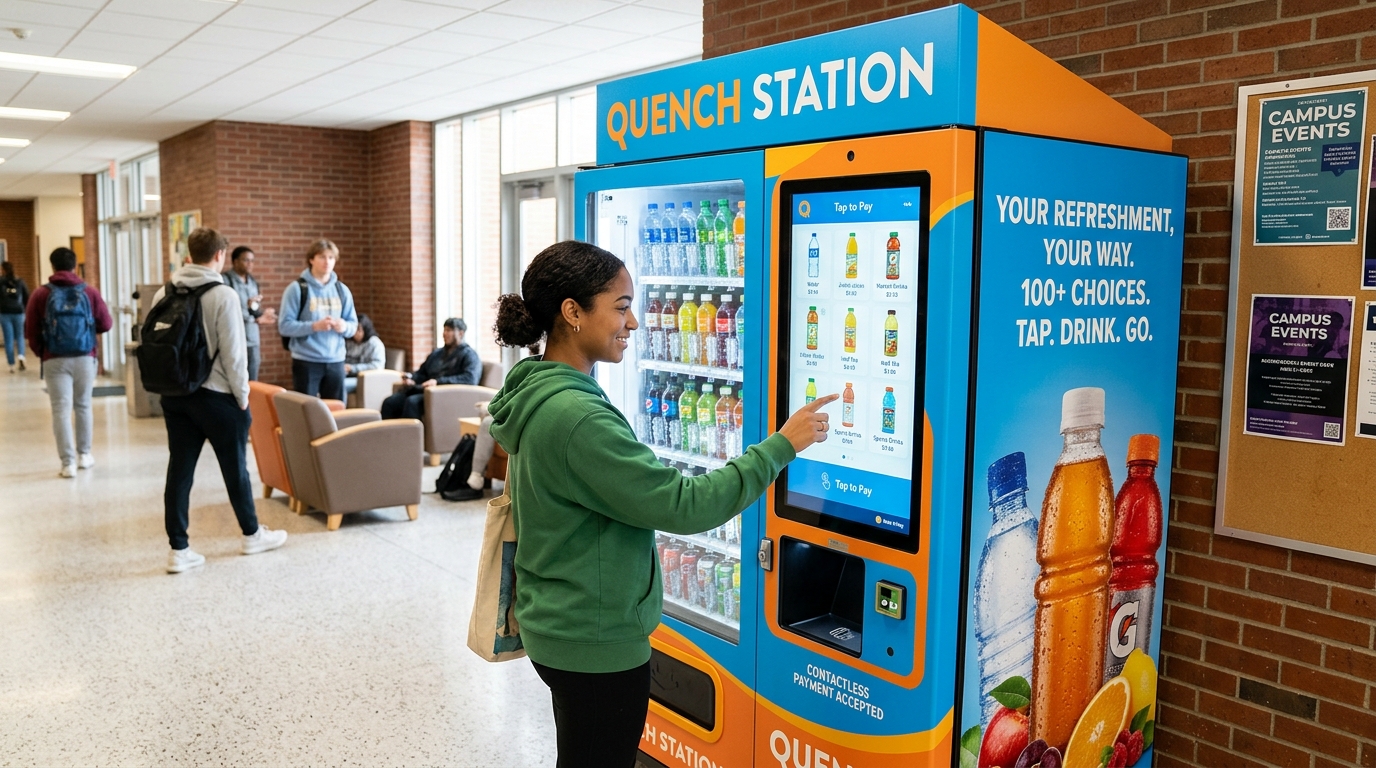
A custom-wrapped machine functions as a point-of-decision retail display rather than a plain steel box, and the difference in customer attention is immediate. Effective wraps layer one clear story onto the cabinet: a logo, a hero product shot, and a short call to action positioned near the payment point, since customers decode a machine’s offer in seconds, not minutes. Color choices are not cosmetic; red tends to signal appetite and urgency while green signals health or eco-conscious options, so wrap colors should match the actual product mix rather than a generic brand palette. Refreshing the wrap seasonally with lower-cost vinyl overlays, rather than a full reprint, keeps the machine visually current without the expense of a complete redesign every quarter.
QR Codes and Instant Promotions at the Point of Sale
A QR code placed directly at the payment interface converts a static purchase into an interactive one, triggering an instant coupon, a loyalty sign-up, or a limited-time discount the moment a customer is already standing in front of the machine with intent to buy. The strongest-performing codes pair a two-to-four word call to action, “Scan for BOGO” or “Tap and Save”, with the code itself, since an unexplained QR code on a vending machine gets ignored far more often than one with a concrete, immediate benefit attached. This tactic works specifically because it captures the customer at the single moment they are most receptive: after they have already decided to buy something and are deciding what.
Digital Signage and Screen-Based Promotion
A screen on a smart vending machine can run promotional video, seasonal graphics, or sponsor content, but the screen’s first job is always to support the purchase decision, not distract from it. Signage that confuses a customer about how to pay or what to select actively hurts conversion even while technically delivering more “engagement.” The better use case treats the screen as reinforcement: confirming a promotion already advertised on the wrap, displaying a QR payment guide, or rotating limited-time offers tied to actual inventory rather than generic branded content unrelated to what is in stock that week.
Payment Friction as a Marketing Lever
Payment method is usually filed under operations, not marketing, but the data makes clear it belongs in both categories. Removing friction at checkout is one of the highest-return marketing moves available to a vending operator, because it directly increases both purchase frequency and transaction size.
Cashless Adoption and Spend-Per-Transaction Data
Cashless payment adoption in U.S. vending reached roughly 71 percent of all transactions in 2024, a 17-percentage-point jump from the year before, and industry reporting places 2026 adoption above 80 percent of transactions nationwide. The revenue impact is not marginal: cashless customers spend 35 to 40 percent more per transaction than cash buyers across multiple independent industry sources, a gap consistent enough to treat as a reliable planning figure rather than an outlier statistic (vending payment trend reporting). This means a machine still running cash-only in 2026 is not simply behind on convenience, it is measurably underperforming its cashless-equipped peers on every metric that matters to revenue.
Mobile Wallets and Impulse Purchase Behavior
Mobile payments now contribute nearly one-third of all cashless vending sales, and the mechanism behind the lift is straightforward cause and effect: removing the need to count exact change or locate a card removes the hesitation window where an impulse purchase talks itself out of happening. Tap-to-pay and QR-based mobile wallet payments compress the decision-to-purchase interval to a single tap, which is precisely the window where impulse-driven beverage purchases live. Operators evaluating new machines should weigh payment terminal compatibility as heavily as they weigh drink vending machine pricing, since the payment stack itself is now a revenue driver rather than a checkout formality.
Loyalty Programs and Repeat-Purchase Marketing
A location with steady daily traffic, an office, a gym, an apartment building, rewards loyalty marketing more than a one-off public spot ever will, because the same customers return repeatedly and a well-designed program compounds their lifetime value rather than chasing a fresh audience each week.
Digital Punch Cards and App-Based Rewards
A digital punch card tied to a phone number or email address recreates the classic buy-nine-get-one-free mechanic without requiring a physical card that gets lost or forgotten. The mechanism is simple and the psychology behind it well established: a visible progress toward a free reward increases purchase frequency more reliably than an equivalent flat discount offered upfront, because the reward feels earned rather than given. Pairing the loyalty sign-up with the QR code at the payment point, rather than a separate app download step, keeps enrollment friction low enough that a meaningful share of regular customers actually complete it.
Personalization Through Purchase Data
Once a loyalty program captures purchase history, personalized offers become possible without any manual segmentation work: a customer who buys the same sports drink three times a week can be served a targeted discount on that exact product rather than a generic storewide promotion that is less likely to convert. This is where machine-level telemetry and CRM integration compound each other, since the purchase data feeding the loyalty program is the same data that should be informing restocking decisions and the day-to-day operation of the machine itself.
Local and Location-Based Marketing
A vending machine only sells to the people who already know it exists, and for a fixed-location business, local visibility is disproportionately valuable compared to broad-reach advertising that never reaches anyone within walking distance of the actual machine.
Google Business Profile and Local Search Visibility
Registering each vending location, or the vending route as a business, on Google Business Profile puts the operator into local search results for queries like “vending machine near me,” a search pattern with clear commercial intent since the person searching is actively looking to buy in the next few minutes. Encouraging satisfied customers to leave a quick review after a smooth transaction builds the review volume that improves local search ranking over time, and responding to any negative review promptly signals active management to both the reviewer and to anyone reading reviews before deciding whether to trust a given machine.
Cross-Promotion With the Host Location
The business hosting a vending machine already has an audience, and partnering with it multiplies reach at effectively no additional cost. Offering a discount code specific to a host’s employees or members, a “buy one get one” deal redeemable only by that location’s badge holders, for instance, creates a mutually beneficial relationship that drives foot traffic to the machine while giving the host an amenity worth promoting to their own audience. This works especially well at gyms, offices, and residential buildings where the host already communicates regularly with the exact people the machine is trying to reach. Matching this kind of promotion to a location genuinely suited to beverage sales starts with choosing the right placement location in the first place, since even the best cross-promotion cannot compensate for a site with low natural traffic.
Social Media and Content Marketing for Vending Routes
Social media plays a narrower but real role in vending marketing: it builds awareness of the machine or the route beyond the people who happen to walk past it. Posting visually appealing content, a newly stocked machine, a seasonal wrap refresh, a limited-time drink lineup, on platforms like Instagram and Facebook, tagged with location-based hashtags and the nearby business’s own handle, extends reach into that business’s existing follower base. Encouraging customers to share their own photos and tag the machine or brand adds a layer of authentic word-of-mouth that paid content cannot replicate, since a peer recommendation carries more weight than an operator’s own promotional post. This tactic works best as a supplement to strong machine-level and local marketing, not a replacement for it, since social reach rarely converts directly without a customer already being near the physical machine.
Data-Driven Merchandising as a Marketing Tool
Merchandising decisions are marketing decisions once framed correctly: the product mix a machine carries is itself a message about who the machine is for and what it expects them to want. Telemetry from a smart vending machine reports which SKUs sell fastest, which sit unsold long enough to risk spoilage or staleness, and which time slots see the highest transaction volume, turning restocking from a routine chore into an ongoing merchandising experiment. Operators who review this data weekly and adjust the planogram accordingly consistently outperform operators who set a product mix once and leave it static for months.
A/B testing promotions works the same way a retail chain tests pricing: run one offer for two to four weeks, measure the lift against a baseline period, and keep only what moves the needle. A single variable per test, price point, wrap message, or QR incentive, keeps the results interpretable rather than muddying the signal with multiple simultaneous changes. This same discipline extends to catching operational problems before they become marketing problems; a machine with a recurring jam issue undermines every promotion running on it, so knowing how to resolve a stuck drink quickly protects the customer experience your marketing is working to build.
Marketing Tactics Compared
| Tactic | Setup Effort | Ongoing Cost | Best For |
|---|---|---|---|
| Custom wrap / branding | Moderate | Low | First impression, brand recall |
| QR-triggered promotions | Low | Very low | Instant conversion at point of sale |
| Digital signage | High | Moderate | High-traffic, smart-machine locations |
| Cashless / mobile payment | Moderate | Transaction fees | Every location, no exceptions |
| Loyalty program | Moderate | Low | High-frequency, repeat-visit sites |
| Google Business Profile | Low | Free | Public-access, walk-up locations |
| Host cross-promotion | Low | Free to low | Offices, gyms, residential buildings |
- Trackable, attributable results per promotion
- Scales across a whole route without per-machine labor
- Enables personalization based on real purchase data
- Requires smart-machine hardware and connectivity
- Higher upfront and maintenance cost than static wraps
- Screen content can distract from the core purchase if poorly designed
Seasonal and Event-Based Promotions
Seasonal marketing gives a vending machine a reason to look different and feel current without a full equipment change. A summer wrap refresh emphasizing cold beverages and hydration messaging, paired with a QR-triggered discount during a heat wave, taps into demand that is already there rather than trying to create it. Around major local events, a nearby conference, a sports tournament, a campus move-in week, a short-term promotion tied to the specific occasion consistently outperforms a generic ongoing discount, because it creates urgency and relevance that a standing offer cannot replicate. Limited-run flavor drops or co-branded promotions timed to a cultural moment work the same way a retail “drop” does: scarcity and timing do more to drive action than the size of the discount itself.
Common Marketing Mistakes
Running signage or promotions that confuse rather than guide the purchase decision is the most common execution error, since a screen or wrap that distracts from the payment flow measurably hurts conversion even while appearing to increase engagement. Setting a product mix once and never revisiting it wastes the single richest data source an operator has, purchase telemetry, in favor of guesswork that grows stale the moment local demand shifts. Running a loyalty program with no simple enrollment path, requiring an app download before a customer even makes their first purchase, kills participation before it starts; enrollment should happen at or near the point of sale, not as a separate later step. Finally, ignoring the host location as a marketing partner leaves free reach on the table, since a discount code shared through an office newsletter or gym app costs nothing and reaches an audience already primed to buy.
Start With a Machine Built to Sell
Browse cashless-ready, smart drink vending machines built for wraps, QR promotions, and telemetry-driven merchandising from day one.
Shop Drink Vending MachinesRunning a co-branded promotion or a location-specific wrap? A configured build makes the marketing plan possible from the hardware up.
Build a Custom Drink Vending Machine
Spec a beverage machine around your wrap, screen, payment stack, and promotional plans for a specific location.
Configure Your MachineMachines Built for Cashless, Data-Driven Marketing
These units support the payment flexibility and telemetry that modern vending marketing depends on:
Key Takeaways
- Cashless payment is a marketing lever, not just convenience. Cashless customers spend 35 to 40 percent more per transaction than cash buyers.
- The machine is the storefront. Wraps, QR codes, and screens all directly influence the purchase decision in the seconds a customer stands in front of it.
- Loyalty programs should enroll at the point of sale, not require a separate app download step that kills participation before it starts.
- Local visibility compounds for free. A Google Business Profile and host cross-promotion cost little and reach people already near the machine.
- Purchase data should drive the product mix continuously, not inform a planogram set once and left untouched.
- Fix operational reliability first. No promotion outperforms a machine that jams or sits poorly stocked.